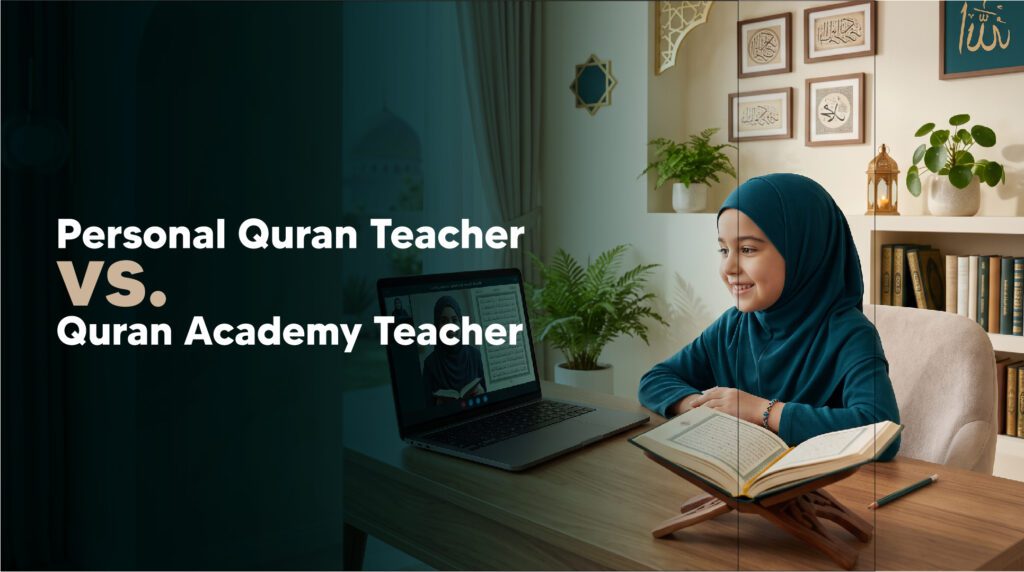
Choosing the right teacher is one of the most important decisions parents make when looking for online Quran classes for their children. Many parents ask:
“Should I hire a personal Quran teacher or enroll my child in an online Quran academy?”
Both options can provide Quran education, but there are important differences that parents should consider—especially when it comes to teacher accountability, student progress, Islamic Tarbiyah, and long-term learning.
1. Personal Quran Teacher
A personal Quran teacher can offer one-to-one Quran lessons, which can be a good option for some children. The teacher may focus directly on the child’s Quran reading, memorization, or Tajweed.
However, one important question is who is responsible for monitoring the teacher?
If a parent hires an individual teacher directly, there may be no academic management team regularly checking:
- Whether the teacher is attending classes on time
- How well the teacher is teaching
- Whether the child is making progress
- Whether the teacher is following a proper curriculum
- Whether the child needs additional Islamic education
- How the teacher responds to learning difficulties
If there is a problem, the parent usually has to deal with it directly.
2. Online Quran Academy Teacher
A teacher working through a professional online Quran academy is normally part of a larger educational system.
The academy can monitor teachers, check student attendance, review progress, receive feedback from parents, and make improvements when necessary.
This creates an additional level of accountability.
A professional academy may have systems for:
- Teacher supervision
- Student attendance
- Regular assessments and examinations
- Student progress reports
- Parent communication
- Teacher performance monitoring
- Quran and Tajweed curriculum
- Islamic Tarbiyah and character building
This means parents are not depending only on one teacher. There is an academy management team behind the teacher.
3. What Happens If the Teacher Is Not Performing Well?
This is one of the biggest differences parents should consider.
With a personal teacher, changing teachers can sometimes mean starting the search again.
With an online Quran academy, parents can usually communicate with the academy management and request support if the teacher is not suitable for their child.
A professional academy should have a system to identify teaching problems and take appropriate action.
4. Look Beyond Quran Reading
Parents should also consider what their child is learning besides Quran recitation.
A good online Islamic academy for kids should not focus only on reading the Quran. Children also need Islamic Tarbiyah, Islamic manners, duas, ethics, and character building.
The purpose of Islamic education is not simply to teach a child how to read the Quran. It should also help them become a responsible, respectful, honest, and practicing Muslim.
So, Which One Should Parents Choose?
A personal Quran teacher can be a good choice if the teacher is qualified, trustworthy, experienced, and consistently monitored by the parents.
However, for parents who want a structured, accountable, and complete Islamic education system, an established online Quran academy can offer important advantages.
Before choosing, don’t ask only:
“Is the teacher good?”
Also ask:
“Who supervises the teacher?”
“How is my child’s progress monitored?”
“Are there regular tests and assessments?”
“Does the academy provide Islamic Tarbiyah?”
“Who will take responsibility if my child is not progressing?”
The Right Choice Is About More Than a Teacher
Your child’s Quran education is a long-term responsibility. Choose an educational system where the teacher is not working alone, but is supported by supervision, accountability, assessment, curriculum, and Islamic Tarbiyah.
Because when it comes to your child’s Islamic education, a good teacher is important—but a good system is even more important.